Hair · 21 Oct 2026 · 9 min read
Hair Fall Treatment in Gurgaon: When to See a Specialist
Shedding more than usual? Learn how much hair fall is normal, what causes it, and when it is time to see a specialist in Gurgaon.
Read article
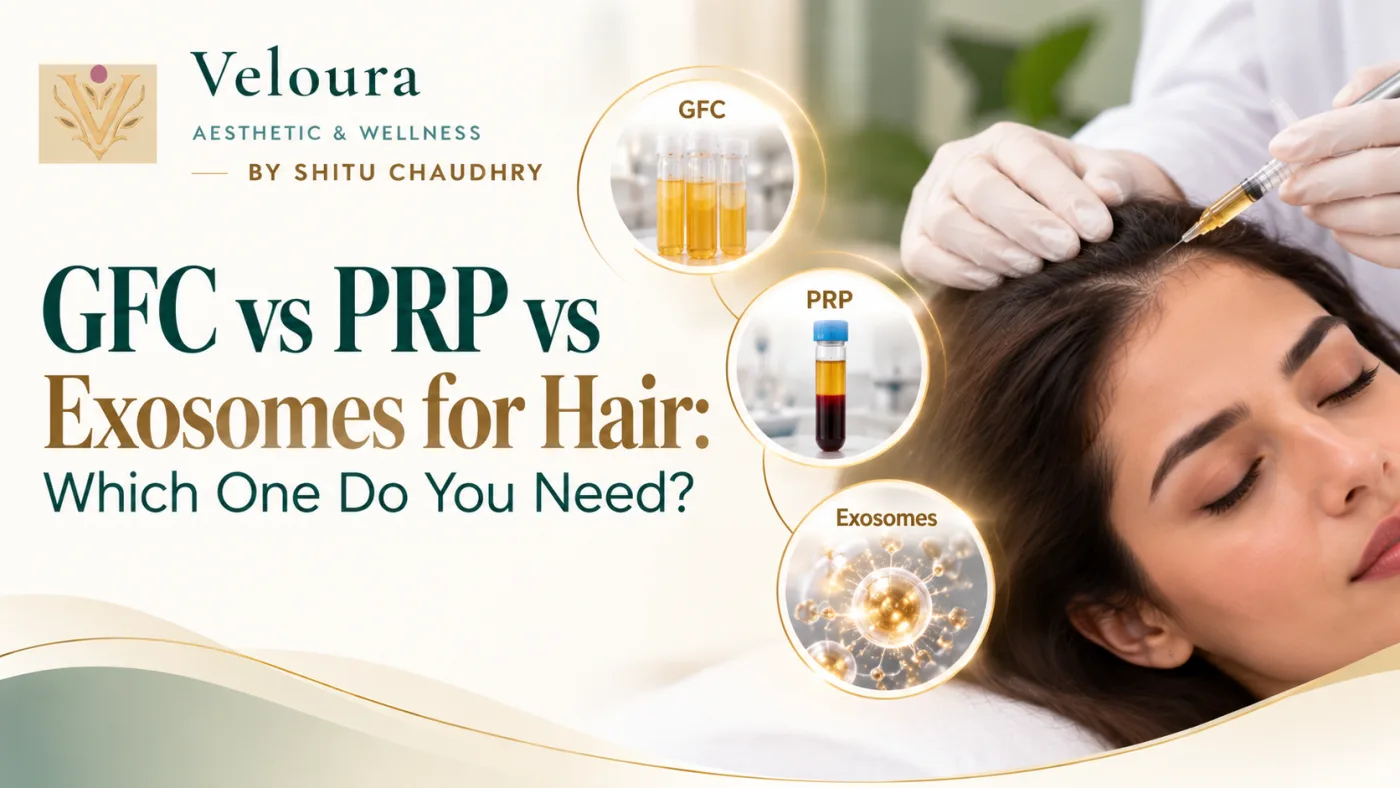
If you have started looking into hair fall treatments, you have probably come across three names again and again: PRP, GFC, and exosomes. Clinics talk about all three as ways to strengthen weak hair and support regrowth. The names sound technical, the explanations often sound similar, and it is hard to tell which one you actually need.
The short answer: they are related, but they are not the same. PRP and GFC both come from your own blood, but they are prepared differently. Exosomes are a newer type of treatment that works on a different idea altogether.
This guide explains GFC vs PRP vs exosomes in plain language, how each one works, who it suits, what to expect from sessions and results, and how to decide which is right for your hair.
WhatsApp Us About Hair Treatment
PRP stands for Platelet-Rich Plasma. A small amount of your blood is drawn and spun in a machine called a centrifuge, which separates the platelets from the rest of the blood. Platelets carry growth factors, natural proteins that help the body repair tissue. The platelet-rich plasma is then injected into the thinning areas of the scalp.
Who it suits: early hair thinning, mild pattern hair loss, and people who want a treatment made from their own blood.
What to expect: multiple injections are given across the scalp, so there is some discomfort, and the scalp can feel tender or look slightly red for a day or two. A typical course is a series of sessions spaced a few weeks apart, followed by maintenance if needed.
Limits: PRP contains platelets along with other blood cells, such as red and white cells, which can cause more soreness and swelling. How much the growth factors help can also vary from one preparation to the next.
GFC hair treatment stands for Growth Factor Concentrate. Like PRP, it starts with a small sample of your own blood. The difference is in the preparation. The platelets are activated, and the growth factors they release are separated, leaving a cleaner concentrate with fewer red and white blood cells.
In the GFC vs PRP comparison, GFC is often described as a refinement of PRP. Because the solution is more concentrated and cleaner, some people find the sessions more comfortable, with less swelling and soreness afterwards. PRP, however, has the longer track record, and which one suits you is decided at consultation.
GFC mesotherapy is simply the way GFC is delivered. Mesotherapy means placing very small amounts of a solution into the middle layer of the skin through many fine, shallow injections across the scalp, so the growth factors reach the area around the hair follicles evenly.
Who it suits: early to moderate thinning, a widening parting, a thinning crown, post-illness or post-pregnancy shedding that has not fully recovered, and people who tried PRP and found it uncomfortable.
What to expect: a course is often a series of sessions spaced a few weeks apart, with maintenance sessions after that. Most people go back to work the same day.
Exosomes are tiny particles that cells release to send signals to other cells. In hair exosome therapy, a prepared exosome solution is applied to the scalp, usually with microneedling or fine injections, to support the signals that keep hair follicles active.
The main difference from PRP and GFC is the source. PRP and GFC are made from your own blood on the day. Exosome products are prepared in a lab, so no blood needs to be drawn.
Who it suits: people who prefer not to have blood drawn, people looking for a regenerative option alongside other treatments, and some cases of thinning where other options have given limited results.
What to expect: there may be mild redness or tenderness for a day or two. The number of sessions depends on the product, the delivery method, and your hair.
What to know: exosome treatment for hair is newer than PRP and GFC, and research is still growing. Results vary, and product quality and sourcing matter a lot. Any clinic offering exosomes should explain clearly what product they use and what it can and cannot do.
| PRP | GFC | Exosomes | |
|---|---|---|---|
| Source | Your own blood | Your own blood | Lab-prepared product |
| Blood draw needed | Yes | Yes | No |
| What goes into the scalp | Plasma rich in platelets, with some other blood cells | Concentrated growth factors, fewer other cells | Signalling particles (exosomes) |
| Comfort | More soreness and swelling for some | Often described as more comfortable than PRP | Mild redness or tenderness |
| Typical course | A series of sessions a few weeks apart, then maintenance | A series of sessions a few weeks apart, then maintenance | Depends on product and plan |
| How established | Longest track record | Widely used, builds on PRP | Newest, research still growing |
| Often suits | Early thinning | Early to moderate thinning | Regenerative support, no-blood preference |
Sessions and timelines are typical ranges, not fixed plans. Your own course depends on the cause and stage of your hair loss.
The right choice depends less on which treatment sounds most advanced and more on why your hair is thinning. Here is how the decision usually works:
Whatever you choose, scalp treatments work best when underlying issues such as low iron, thyroid imbalance, or hormonal changes are also checked by your physician.
Call Us to Discuss Your Hair Treatment
At Veloura Aesthetics & Wellness, a hair regrowth treatment in Gurgaon starts with finding out why your hair is thinning, not with choosing between GFC, PRP, or exosomes.
What your consultation covers:
Why people choose Veloura for hair treatment:
What results to expect: most people notice less shedding first. Visible improvement in density usually takes three to six months, because hair grows slowly. Results vary with the cause, the stage of hair loss, and how consistently the plan is followed.
Both are made from your own blood. PRP uses plasma rich in platelets, along with some other blood cells. GFC goes a step further by activating the platelets and separating a cleaner concentrate of growth factors.
Not necessarily. Some people find GFC more comfortable, with less swelling, because the solution is cleaner and more concentrated. PRP has the longer track record. Which works better for you depends on your hair loss, so it is decided at consultation.
It is the way GFC is delivered: many tiny, shallow injections across the scalp place the growth factors evenly near the hair follicles.
Not necessarily. Exosomes are newer and need no blood draw, but research is still growing. GFC has a longer track record. Some people benefit from using both.
A course is usually a series of sessions spaced a few weeks apart, followed by maintenance. The exact number depends on your hair and how it responds.
There is some discomfort from the injections, but most people find it manageable, and some find it more comfortable than PRP.
Less shedding is usually noticed first. Visible improvement in hair density commonly takes three to six months.
Cost depends on the treatment, the area of the scalp treated, and the number of sessions. You get an accurate quote after your consultation.
PRP, GFC, and exosomes can all play a role in hair restoration, but the best option is the one that matches the cause and stage of your hair loss. Comparing names online only gets you so far. If you are considering hair regrowth treatment in Gurgaon, book a consultation at Veloura Aesthetics & Wellness in Sector 28, and get a clear answer on what your hair actually needs.
This page is general information and is not a substitute for a medical consultation. Suitability for any treatment can only be assessed in person by a qualified clinician, who will review your history, medication and skin before recommending anything.
Keep reading
Hair · 21 Oct 2026 · 9 min read
Shedding more than usual? Learn how much hair fall is normal, what causes it, and when it is time to see a specialist in Gurgaon.
Read article
Hair · 21 Oct 2026 · 9 min read
Hair thinning, shedding or a widening parting? Learn the common causes of hair loss in women and the treatment options available in Gurgaon.
Read article
Anti-Ageing · 26 Oct 2026 · 8 min read
How skin changes in your 20s, 30s, 40s and 50s+, and which anti-ageing treatments in Gurgaon tend to suit each stage.
Read articleBegin
Ninety minutes, no obligation, and an honest answer about what is — and is not — worth doing.
Mon – Sun · 10:00 am – 7:00 pm · Huda Market, Sector 28, Gurugram